Robin's Hut
Studion Weave, 2009
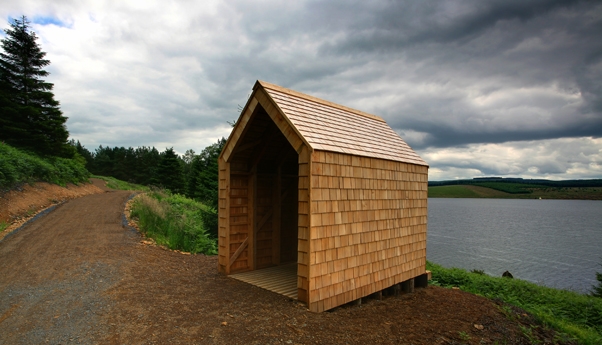
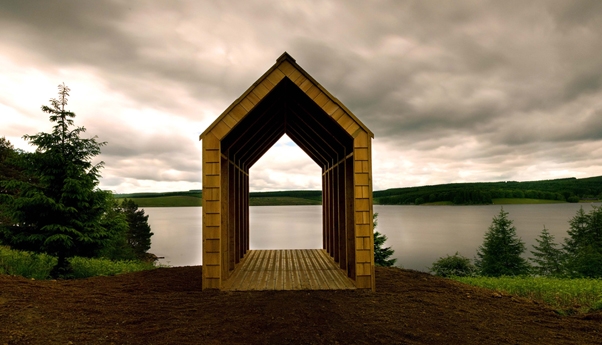
Robin’s Hut is one of a pair of small buildings located on opposite sides of the Kielder Water along the Lakeside Way. The two buildings, Robin’s Hut and Freya’s Cabin, are linked by the story of Freya & Robin, which tells a tale of the two characters who live by the lake and their efforts to meet up. Robin’s Hut is a simple cedar shingle clad open-ended timber structure sited on the more remote north shoreline of Kielder Water. Find out how the designers’ experiences on that day fired their imaginations by reading Freya and Robin’s story which can be found in either shelter.
The nearest parking is at Hawkhope car park. Robin’s Hut is located about 4.75 miles or around 2 hours walk time along the Lakeside Way north shore heading towards Kielder Village. A good way to explore all the artworks along the Lakeside Way is by cycle. Bikes should be to at least hybrid cycle grade with decent country tyres for the changing terrain of Kielder Water & Forest Park.
Map Ref: NY 671883
Architects Studio Weave imagined the story of Freya and Robin after visiting Kielder in March when the bright sun was low in the sky even in the middle of the day. From the location of Freya’s Cabin, the whole of the north shore where Robin’s Hut now sits was brightly illuminated and it was easy to make out the tiniest detail. From the site of Robin’s Hut, viewing the south shore meant looking into the sun and made it much more difficult to make out the details of the landscape. This direct experience of the landscape and weather conditions at Kielder resulted in the story of Freya & Robin and the design of the two quirky shelters that now face each other across the lake. Local joiner Gavin Tremble worked during the spring of 2009 to construct the building from a series of portal frames, set onto timber piles, and covered with a skin of cedar shingles.
Studio Weave is a young energetic architecture practice run by Je Ahn and Maria Smith, who have worked on a diverse set of projects across the country. Their work ranges from furniture and exhibition design, through shelters, follies and buildings, to urban landscapes and urban planning, working with private and public clients and in collaboration with a diverse network of craftspeople. The architects say: “We aim to create places through playing into and exploring the unique aspects of a site: its physical and geographical qualities, its use both currently and historically, as well as its myths and legends, real and imagined. We particularly appreciate the quirky and eccentric characteristics that make somewhere distinctive and we’re always on the look out for alluring narrative arcs to inform our proposals. We begin every project with an extremely open mind and we love working closely with everyone surrounding a project to create something unique to them. Our approach to realising a project is to cherish these idiosyncratic beginnings and work closely with makers to create a highly-crafted outcome that conveys its histories and the skill and flair of all those who made it.”
Robin’s Hut lies on the Lakeside Way between the Belvedere, a mile to the east, and Salmon Cubes, just short of 2 miles to the west. Along the route to the Salmon Cubes, the Lakeside Way first passes close to Plashett’s Quarry which is split into an active part above the track providing Whinstone for the Forestry Commission and a lower flooded section that was a source for the stone used in the construction of Kielder Dam in the late 1970’s. A mile beyond the quarry the Lakeside Way crosses Plashett’s Incline at right angles. Although this now looks like a straight access route down to a slipway on the shoreline, at the end of the 19th century this was a railway track, or inclined plane, that brought coal down from Plashett’s mine, 2 miles away up on the hill, to a depot in the valley from where the coal could be exported to England or Scotland via the Border Counties Railway.